Pattern tool
Generate your kimono pattern PDF.
Women's basic style. Print on A4 or US Letter. Your measurements never leave your browser.
Sample preview
This is what you'll download.
Real pages from a sample PDF generated with average women's metric measurements (160 cm tall). Your PDF replaces these dimensions with yours and otherwise looks the same.
Scroll →
-
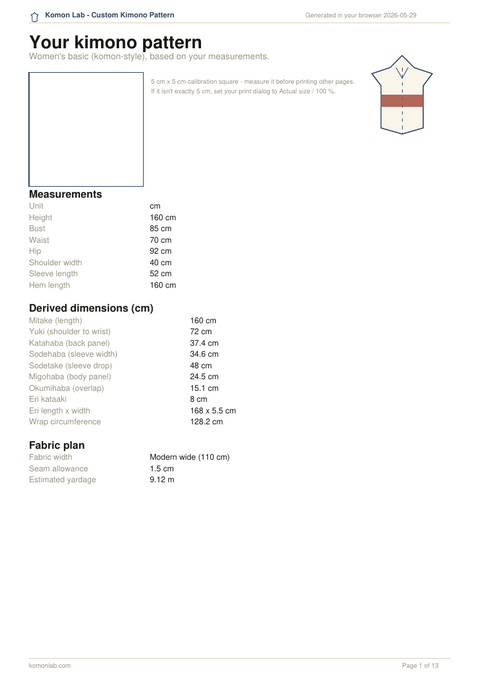
Page 1: Summary & calibration -
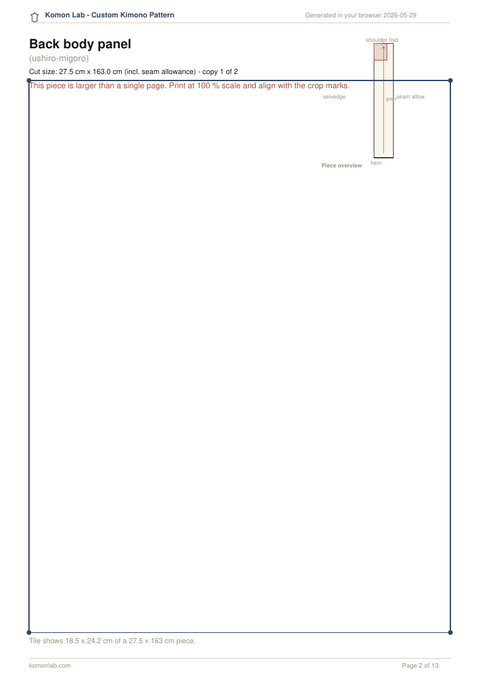
Page 2-3: Back body panels -
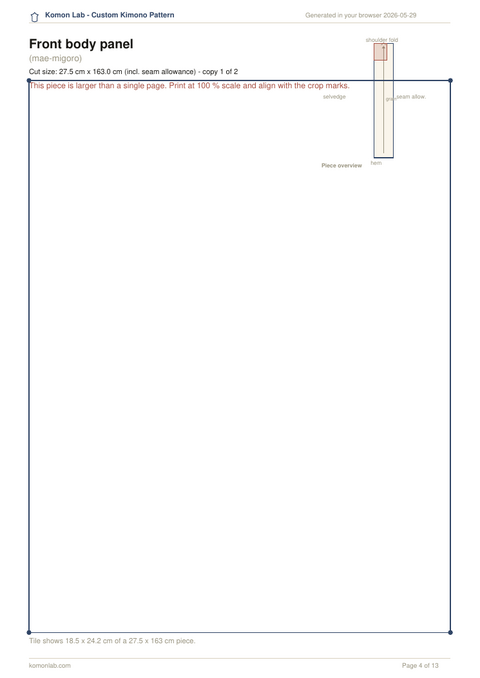
Page 4-5: Front body panels -
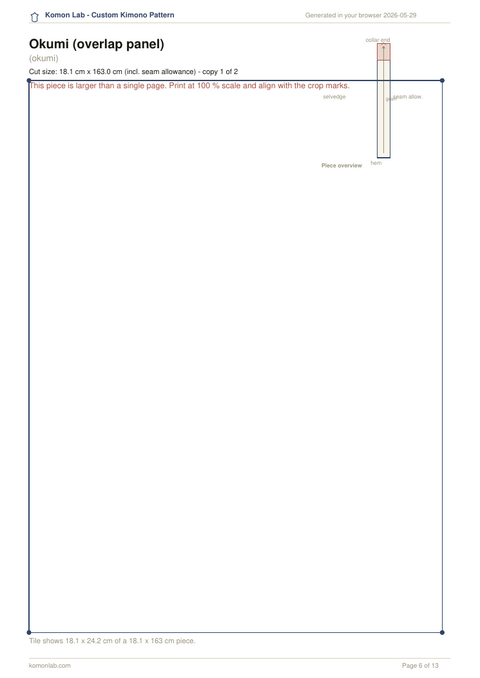
Page 6-7: Okumi overlap -
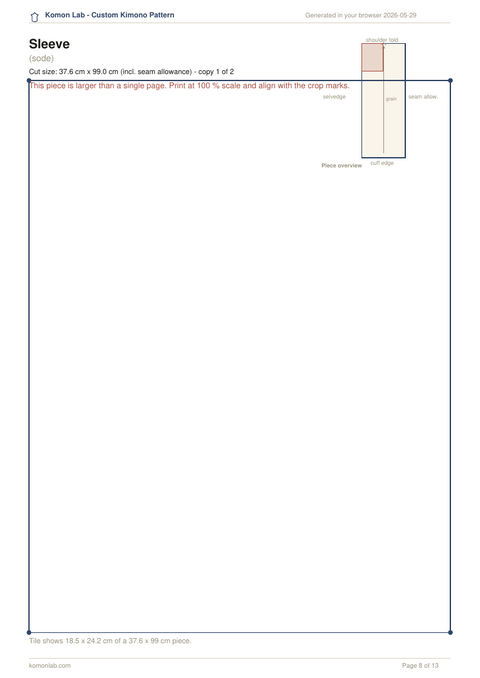
Page 8-9: Sleeves -
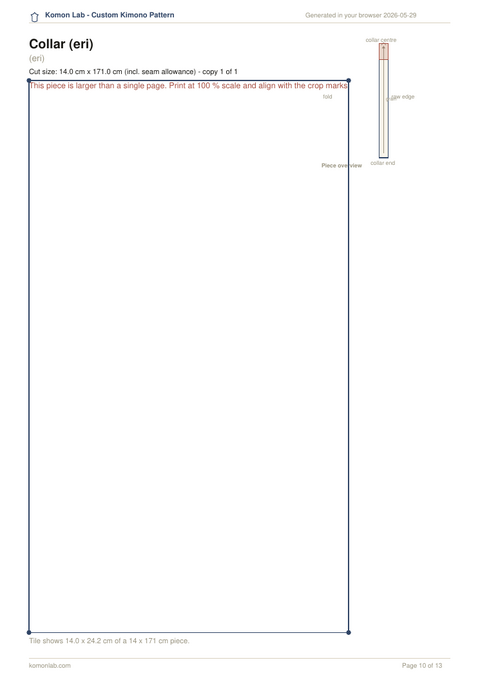
Page 10: Collar (eri) -
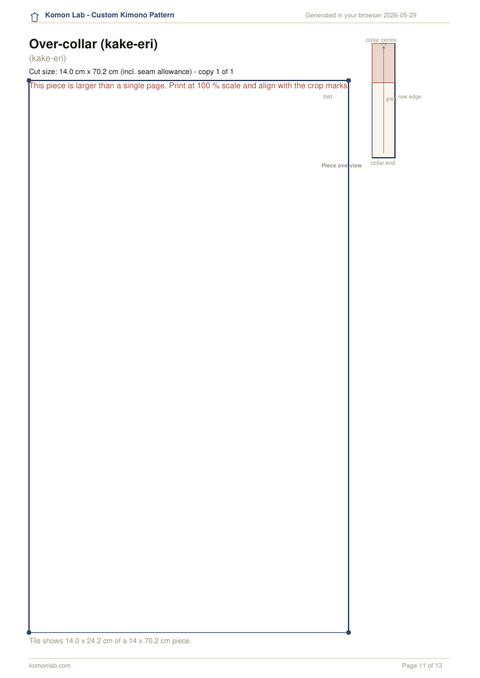
Page 11: Over-collar (kake-eri) -
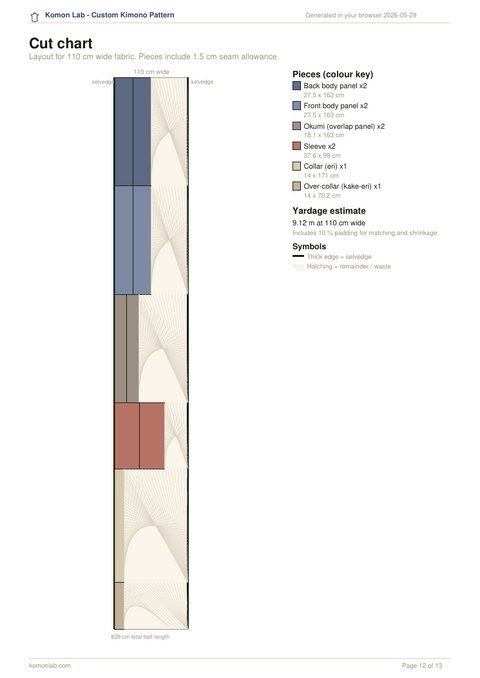
Page 12: Cut chart -
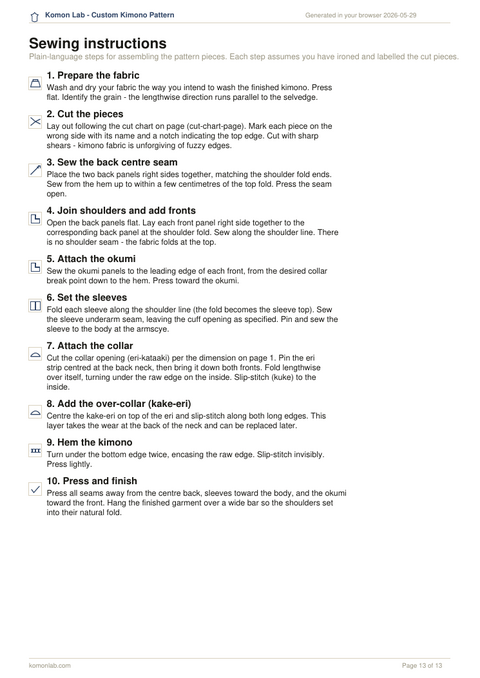
Page 13: Sewing instructions
How to print
- Open the downloaded PDF in your system viewer (Preview, Acrobat, or your browser).
- In the print dialog, set Scale to 100 % / Actual size. Do not use "Fit to page."
- Print page 1 first. It contains a 5 cm calibration square - measure it with a ruler before printing the rest.
- Use a glue stick or low-tack tape to assemble tiled pattern pieces along the alignment marks.
A note on what this is, and isn't
This is an honest first-pass pattern, computed from your measurements using traditional wasai proportions. It will produce a sewable, recognisable kimono for most adult bodies near the middle of the size distribution. It is not a substitute for a fitted muslin if you have any unusual asymmetry, posture, or proportions.
If the output looks wrong, it probably is. Trust your eyes - and please tell us what failed so the next version is better.
FAQ
Common questions about the pattern tool.
+Is the kimono pattern generator really free?
Yes. Every PDF is generated for free with no sign-up, no email capture, and no paid tier. Affiliate links to recommended supplies help cover hosting costs but are never required.
+Where do my measurements go?
Nowhere. The maths runs entirely in your browser using JavaScript. Your measurements, the generated pattern, and the PDF never touch our server.
+Does the pattern work with Western fabric widths?
Yes. The tool supports traditional 35 to 38 cm tan-mono bolt widths and modern 110 to 145 cm Western fabric. The cut chart adapts to whichever you choose and gives a yardage estimate.
+Is this pattern authentic wasai?
The proportions follow traditional Japanese wasai rules - rectangular pieces, no curved seams, traditional collar and okumi geometry. It is meant to produce a recognisable, sewable kimono. It is not a substitute for studying with a wasai teacher.
+Can I sew the pattern by machine or do I have to hand-sew?
Either works. Most home sewers machine-sew the long straight seams and hand-sew the collar, hem, and okumi attachment. The guides cover what changes when you mix the two.
+Can I use this pattern for a yukata or a juban?
The current tool draws a women basic kimono. The same body and sleeve maths apply to a yukata (skip the lining) and to a juban (smaller scale, no okumi). Dedicated yukata and juban modes are planned.
+What if the pattern does not fit?
Trust your eyes over the computer. If a piece looks wrong on you, it probably is - make a muslin first if you have any unusual posture, asymmetry, or proportions. Please email the project and tell us what failed so the next version improves.